Ilorin, Kwara State | November 2, 2026
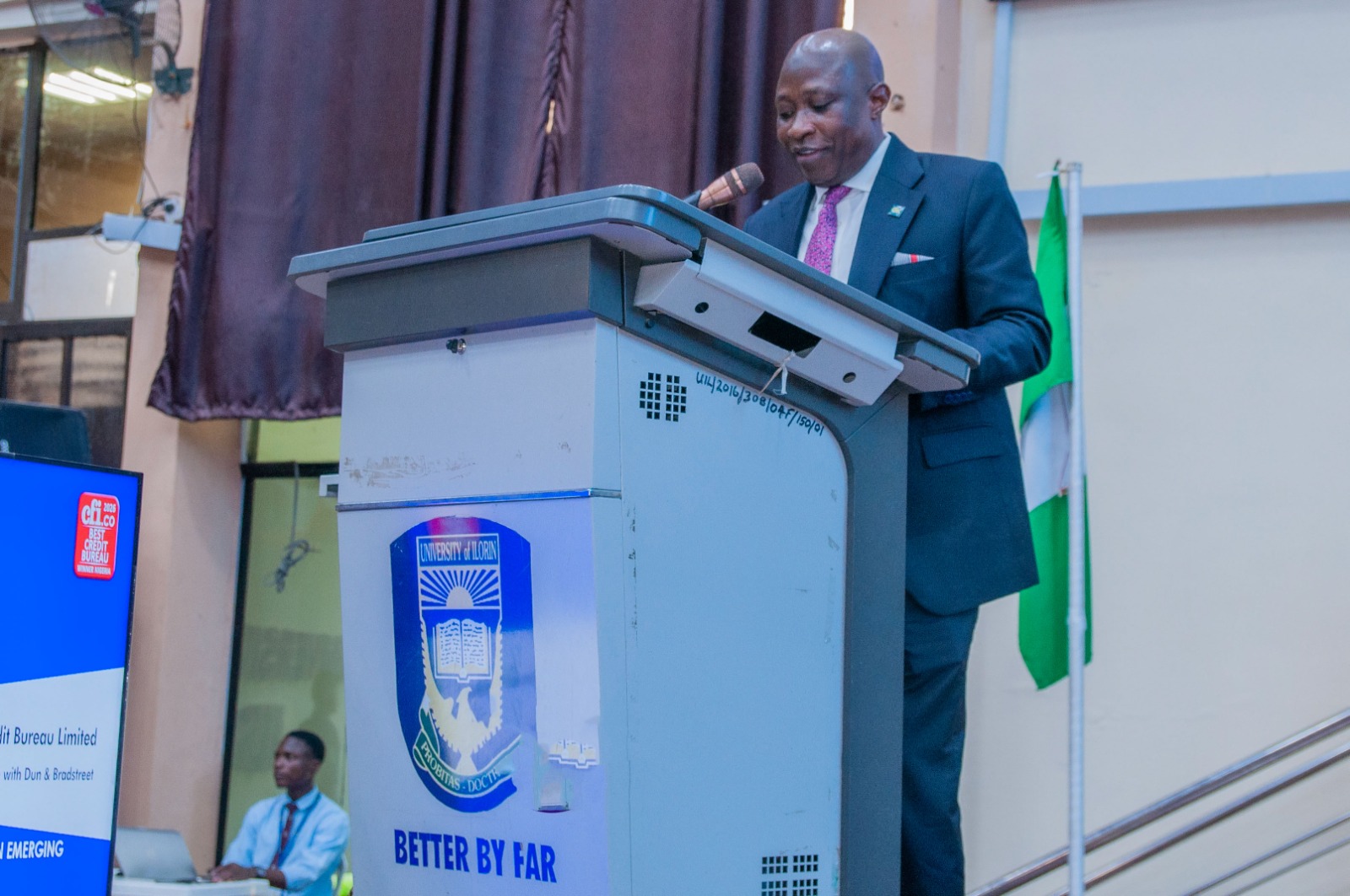
The Managing Director/CEO of CRC Credit Bureau Limited, Dr. ‘Tunde Popoola, has called on African governments, financial institutions, academia, researchers, and policymakers to embrace Artificial Intelligence (AI) as a strategic tool for sustainable development, financial inclusion, and economic transformation. He made the call while delivering the keynote address at the maiden international academic conference organised by the Department of Finance, Faculty of Management Sciences, University of Ilorin on Monday, 2nd November 2026. The conference was themed “Artificial Intelligence, Finance and the Path to Sustainability in Emerging and Developing Countries.”
Dr. Popoola highlighted the sustainability challenges confronting emerging economies, including poverty, climate change, energy deficits, infrastructure gaps, financial exclusion, and weak institutions. He noted that many developing countries remain far from achieving the Sustainable Development Goals, which makes innovative and scalable solutions increasingly important. He explained that finance is central to sustainable development because it mobilises savings, allocates capital, manages risks, and promotes innovation. However, limited access to credit and inadequate financial infrastructure continue to hamper progress, and he cited estimates that achieving the SDGs requires between US$5.4 trillion and US$6.4 trillion in annual financing globally.
Describing AI as a new development equation, he explained that it enables smarter decision-making through advanced data analytics, improves credit assessment, and enhances fraud detection. He added that AI can help address long-standing challenges such as inadequate data, weak institutions, and infrastructure financing deficits. He pointed to global and local financial institutions already using AI for customer service, risk management, credit scoring, and fraud prevention, and he referenced CRC Credit Bureau’s own predictive credit analytics and customer profiling solutions, which support responsible lending and broader access to credit.
On financial inclusion, Dr. Popoola stressed that AI can bring millions of unbanked and underserved people into the formal financial system through mobile money, digital lending, alternative credit scoring, and embedded finance. He noted that this is essential for reducing poverty, supporting MSMEs, creating jobs, and stimulating growth across Africa. He also explained that AI can improve project evaluation, strengthen transparency, support climate adaptation, and help governments combat corruption through more efficient financial management.
While acknowledging these opportunities, he cautioned against the risks of unregulated deployment, including privacy concerns, cybersecurity threats, and ethical challenges. He called for responsible regulation, effective governance frameworks, and robust safeguards so that AI serves humanity positively and sustainably.
In his concluding remarks, Dr. Popoola urged Africa to move beyond being a passive consumer of AI technologies and become an active creator of solutions tailored to its unique challenges. He also noted that generative AI could contribute between US$61 billion and US$103 billion annually to Africa’s economy when deployed at scale. He challenged universities, research institutions, policymakers, regulators, and industry leaders to collaborate on context-specific AI applications that can accelerate sustainable development across the continent.
CRC Credit Bureau Limited is Africa and Nigeria’s foremost credit bureau and a leading provider of credit information, analytics, risk management, and decision-support solutions, committed to financial inclusion, responsible lending, and economic development.